
Introduction to Autofocus SLR Cameras
Autofocus SLR cameras have revolutionized the realm of photography, particularly for beginners who may find the technical aspects of manual focus daunting. These cameras utilize sophisticated autofocus systems that enable users to achieve sharp, well-focused images with minimal effort. Unlike their manual counterparts, autofocus SLR cameras automate the focusing process, allowing novice photographers to concentrate on creative aspects such as composition and lighting rather than the intricacies of focusing.
The significance of autofocus systems in SLR cameras cannot be overstated, especially for individuals just starting their photography journey. Many beginners may be overwhelmed by the myriad of settings and technical jargon associated with photography. Autofocus significantly reduces this barrier, enabling new users to capture clear and detailed images without extensive prior knowledge. This is particularly useful in dynamic situations, such as capturing moving subjects, where precise focusing can be challenging.
Moreover, autofocus technology has advanced tremendously, with various modes available that cater to different shooting situations. For instance, single-shot autofocus is ideal for still subjects, while continuous autofocus is designed to keep moving subjects in focus as they traverse the frame. This versatility allows beginners to experiment with various styles of photography without the added pressure of perfecting their focus manually.
Choosing the right autofocus SLR camera is critical for beginners, as it serves as a foundation for their burgeoning photography skills. With brands like Nikon and Canon offering numerous options equipped with varying autofocus capabilities, understanding these features will help aspiring photographers make informed decisions tailored to their needs. This blog post will provide a comprehensive comparison of Nikon and Canon autofocus SLR cameras, directing beginners toward the most suitable choices for their photographic endeavors.
Overview of the Nikon D3500
The Nikon D3500 is an entry-level digital single-lens reflex (DSLR) camera that has gained significant popularity among budding photographers. One of its most notable features is its 24.2-megapixel (MP) sensor, which delivers impressively detailed images. This high-resolution sensor is particularly beneficial for beginners as it allows for easy cropping and enlargements without sacrificing image quality. The D3500 also offers an ISO range of 100 to 25,600, enabling users to take clear, high-quality photos even in low-light environments, which is a critical need for many who are exploring different photography contexts.
A key selling point of the Nikon D3500 is its user-friendly design, which makes it accessible for those just stepping into the world of photography. The camera incorporates an intuitive interface and features a Guide Mode that assists users in understanding various settings and functions. This mode acts as a tutorial, providing helpful tips and guided assistance while taking photos, effectively bridging the gap between novice and experienced photographers. Additionally, the 11 autofocus points ensure that subjects are captured with precision and speed, allowing users to focus on framing their shots rather than struggling with technical elements.
In practical usage, the Nikon D3500 offers excellent performance across various lighting conditions, thanks to its advanced image processing capabilities. Sample images taken in bright daylight and low-light situations showcase the camera’s ability to maintain clarity and detail, with minimal noise. The combination of these features makes the D3500 not only suitable for beginners but also a versatile tool for those looking to expand their skills in photography. The Nikon D3500 truly stands out as an ideal choice for individuals embarking on their photographic journey.
Overview of the Canon EOS Rebel T7
The Canon EOS Rebel T7 is an exemplary choice for novice photographers seeking to venture into the world of digital SLR cameras. One of its most notable features is the 24.1-megapixel APS-C sensor, which allows users to capture stunningly detailed images. This impressive resolution ensures that photographs retain clarity and sharpness even when printed at larger sizes. The camera’s 9 autofocus points enhance image capture by providing a reliable and efficient focusing mechanism, allowing beginners to achieve accurate focus with minimal effort.
The Canon EOS Rebel T7 is not only equipped with great hardware but also prioritizes user-friendliness. It features a simple interface and intuitive controls, making it accessible for beginners who may feel overwhelmed by complex settings typically found in more advanced models. The presence of built-in Wi-Fi and NFC capabilities further simplifies the workflow by enabling seamless sharing of images and remote camera control using a smartphone or tablet. This feature is particularly beneficial for beginner photographers eager to share their work on social media platforms without the hassle of cumbersome wires.
When it comes to image quality and performance, the Canon EOS Rebel T7 holds its ground across various shooting scenarios. The camera excels in well-lit environments, producing vibrant hues and impressive detail. It also performs reasonably well in low-light conditions, thanks to its capability to handle higher ISO settings with minimal noise. This aspect proves crucial for new photographers who may frequently encounter a range of lighting situations. Overall, the Canon EOS Rebel T7 stands out as a versatile platform for budding photographers to hone their skills while producing high-quality images in a range of settings.
Side-by-Side Comparison: Nikon D3500 vs Canon EOS Rebel T7
The Nikon D3500 and Canon EOS Rebel T7 are two popular choices for beginner photographers seeking robust functionality in autofocus SLR cameras. Both models offer distinct features and specifications that cater to inexperienced users. The Nikon D3500 boasts a 24.2-megapixel APS-C sensor, which provides high-resolution images with excellent detail and clarity. In contrast, the Canon EOS Rebel T7 features a slightly lower 24.1-megapixel APS-C sensor. However, both cameras deliver impressive image quality that can satisfy most novice needs.
When it comes to autofocus systems, the Nikon D3500 is equipped with a 11-point autofocus system. This system includes one cross-type sensor, which aids in more accurate focusing, especially in varied lighting conditions. On the other hand, the Canon EOS Rebel T7 utilizes a 9-point autofocus system, which may suffice for beginners yet offers less precision than the Nikon equivalent. This difference can be significant for users who prioritize capturing fast-moving subjects.
Ease of use is another critical factor for beginners. The Nikon D3500 features a well-designed interface that simplifies the learning curve. Its Guide Mode offers useful tutorials and advice, making it easier for new users to understand various settings. The Canon EOS Rebel T7 also provides a user-friendly interface with an on-screen feature guide, though it lacks the structured support system found in the Nikon model.
In terms of connectivity options, both cameras excel. The Nikon D3500 includes Bluetooth for easy sharing and remote control, while the Canon EOS Rebel T7 features built-in Wi-Fi and NFC for effortless wireless transfers. Ultimately, understanding the strengths and weaknesses of these cameras will enable potential buyers to select the model that best aligns with their photography aspirations and preferences.
My personal preference is the Nikon. I have used both cameras and the Canon uses a memory card (the Nikon does not). I find the memory card a hassle to deal with.

- A DSLR that’s as easy to use as a point and shoot camera
- Compact, comfortable design that’s great for travel and special events
- Image sensor that’s 15x larger than those used in typical smartphones for sharper, clearer pictures
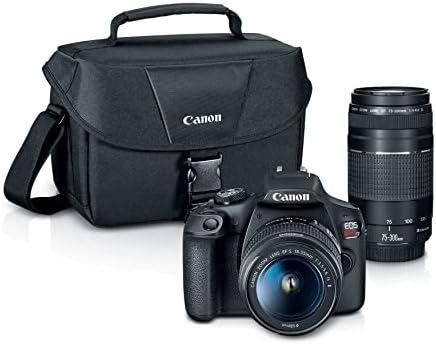
- Improved Dual Pixel CMOS AF and eye detection AF 24.1 Megapixel CMOS (APS-C) sensor with is 100–6400 (H: 12800)
- Built-in Wi-Fi and NFC technology working temperature range: 32-104°F/0-40°C
- 9-Point AF system and AI Servo AF
As an Amazon Associate, I earn from qualifying purchases. This means that if you click on a link and make a purchase, I may receive a small commission at no extra cost to you.